
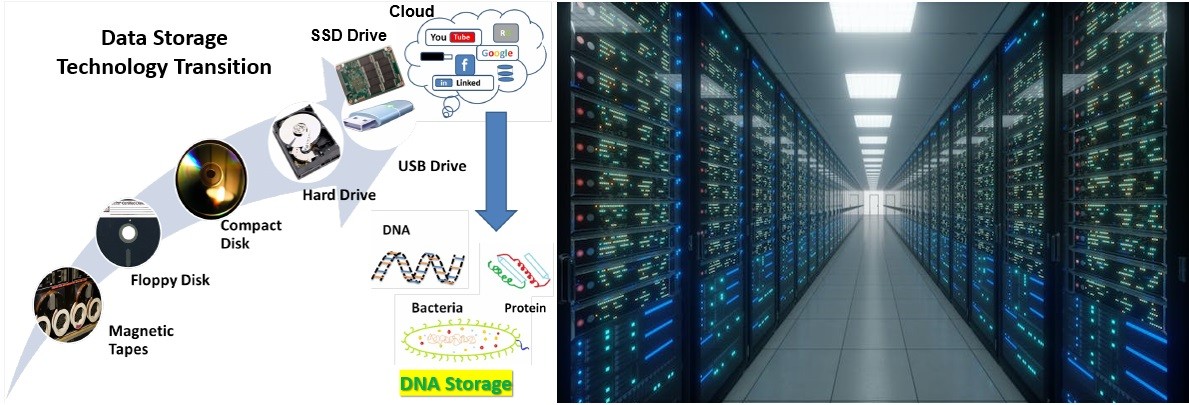
The strangest storage device of the next decade may not look like a drive at all. Molecular Data Storage turns files into chemical code, using DNA’s four-letter alphabet to hold records that may sit untouched for years. The point is not to replace your laptop SSD. It is to protect cold archives: medical scans, legal records, research data, public records, and AI training sets that U.S. organizations cannot afford to lose. For readers tracking the business side of deep tech through technology and data coverage, this field matters because it asks a plain question with a wild answer: what if the future of archives came from biology? DNA has long been studied as a dense and durable carrier of information, yet mainstream use still faces cost, speed, and system-design barriers. Microsoft Research describes DNA storage as an archival path that depends on advances in DNA synthesis, handling, and sequencing, not a near-term consumer drive. That gap between promise and daily use is where the real story sits.
Why Molecular Data Storage Fits the Cold Archive Problem
American data has an awkward habit. It grows fast, then much of it sits still. A hospital may need decades of imaging records. A film studio may keep master files that nobody opens for years. A federal contractor may hold compliance records that matter only when an audit arrives. These files are not “hot” data. They are cold, heavy, and stubborn. The storage choice should match that mood. If a record sleeps most of its life, the best medium may be the one that ages well, not the one that responds in milliseconds.
Why archives are different from normal storage
A normal drive earns its keep by speed. You open a spreadsheet, stream a video, train a model, or search a customer record. Cold archives have a different job. They must survive time, disaster, software changes, and budget cuts. That is why tape libraries still exist in many U.S. companies, even though they feel old next to cloud dashboards. The old tool remains because it fits an old problem: keeping information alive when nobody is cheering for it.
DNA archive systems aim at the same storage tier, not at daily workstations. The non-obvious part is that slow access may be acceptable when the archive is rarely touched. If a city records office stores scanned permits for 80 years, it does not need instant access to every file every morning. It needs trust that the archive will still exist when a title dispute appears. A slow retrieval window can be a fair trade when the record might otherwise be migrated five or six times across changing media.
That makes this technology less like a hard drive and more like a vault. A vault can be slow to open. Nobody complains if the contents are safe. The same logic shapes museum storage, county land records, and medical retention. You do not judge those systems by how fast they serve a movie. You judge them by whether they hold the truth when someone needs it.
The U.S. pressure behind long-term records
The United States creates storage stress from several directions at once. Health systems keep imaging and lab data. Banks keep transaction logs and compliance trails. Universities hold research datasets. Media companies sit on massive video libraries. AI teams save training sets because old data can become useful again after a model update. Even small businesses now carry years of invoices, contracts, chat records, and customer files because deleting data can feel risky.
That last point surprises people. Old files are not always dead files. A dataset that felt boring in 2021 can become valuable in 2026 because a new model, sensor, or legal need changes the question. The archive becomes a reserve of future options. It also becomes a liability when nobody knows what is inside. Storage strategy fails when companies keep everything out of fear but label nothing with care.
This is where long-term cloud archive planning needs a wider view. Keeping copies on magnetic or optical media still works, but it brings migration schedules, energy needs, hardware support, and human process. Nature Reviews Genetics describes DNA as a dense and durable molecular form for archival data, while also pointing to the barriers that still block broad adoption. That mix of strength and friction is the honest frame. The promise is not magic. It is a new candidate for the oldest job in computing.
How Synthetic DNA Storage Turns Files Into Molecules
The basic idea sounds stranger than the workflow. A file starts as binary code, the 0s and 1s used by computers. Software converts that code into sequences made from A, C, G, and T, the four chemical letters of DNA. A lab then makes synthetic strands that carry those sequences. Later, sequencing reads the strands, and software rebuilds the original file. The workflow feels odd because it crosses a border most people keep separate: computers on one side, wet chemistry on the other. In this field, those sides meet.
From bits to bases without treating DNA like magic
Synthetic DNA storage does not put your photo into living cells by default. Most archive research deals with manufactured DNA held outside organisms. That distinction matters. It is chemistry, not a sci-fi creature with your tax documents in its genes. The strands are more like encoded material kept in a controlled container. The file is still a file. The carrier has changed.
The hard part is not the idea of mapping bits to bases. The hard part is doing it without creating fragile patterns. Long runs of the same base can cause errors. Short fragments can arrive out of order. Some strands get lost. Others read with mistakes. So the data needs addresses, checks, and error correction, much like shipping a book as thousands of tiny pages and then rebuilding it later. A family photo archive might tolerate one damaged thumbnail, but a medical image or court record cannot.
A useful comparison is a warehouse with no shelves. If every page lands in one bin, each page needs a label. DNA systems do the same with molecular fragments. They add location clues so the decoder knows where each piece belongs. That extra code reduces raw capacity, but it makes recovery possible. This is the quiet engineering work that rarely gets headlines, yet it decides whether a file comes back clean or comes back as noise.
Reading the archive is harder than writing the dream
The public often hears about density first. That is fair, because DNA can hold a shocking amount of information in a small volume. Microsoft Research says DNA can reach high density and long durability, while also saying it is not yet practical because synthesis and sequencing still need progress. The second half of that sentence deserves as much attention as the first. A tiny archive is only useful if the owner can read it later without a heroic rescue effort.
Writing data into molecules costs money and time. Reading it back also takes lab steps. You do not plug in a vial and browse folders like a USB stick. The system needs controlled handling, sequencing equipment, clean software, and a workflow that can prove the recovered file matches the original. In an enterprise setting, that proof matters. An archive team needs a checksum, a chain of custody, and a record of who requested the read.
That is why near-term digital information storage in DNA makes the most sense for data that people rarely retrieve. A state archive, cancer research center, or entertainment studio can wait longer for recovery than a bank fraud system or video editing team. Speed is not the first win. Staying power is. The irony is that the most advanced storage idea may first serve the least glamorous files.
What Makes DNA Archive Systems So Appealing and So Difficult
A good archive medium has to do boring work for a long time. It should not need constant babysitting. It should not take up too much space. It should not demand endless power for files that might sleep for a generation. DNA checks those boxes in theory. The catch is that theory needs hardware, standards, and repeatable operations. A lab result is exciting. A storage service has to be dull, documented, and repeatable on a bad Tuesday.
Density changes the shape of storage rooms
The density argument is not about neat lab trivia. It changes real estate. A data center has land, power, cooling, racks, fire plans, staff routes, and replacement cycles. If a slice of long-term storage could shrink from rooms to small protected containers, the economics would look different. Space would not disappear as a cost, but it could move from racks and aisles to vault design, catalog systems, and sample handling.
That does not mean every archive should move to DNA. It means the space problem is worth attacking. Imec notes that DNA can store digital information in tiny volumes and remain stable for long periods under the right conditions, while also listing slow read-write times, costs, equipment, and staffing as barriers. Those caveats are not footnotes. They decide who can use the technology first. A small law office will not build a molecular workflow before a national lab does.
Here is the counterintuitive part: the first buyers may not be the companies with the most data. They may be the groups with the highest pain around preservation. A studio protecting original film scans, a defense lab keeping mission records, or a hospital network storing rare disease data may care more about survival than cheap bulk capacity. Synthetic DNA storage may enter through value per file, not volume per company.
Standards matter more than flashy demos
A demo proves a message can survive. A storage market needs much more. It needs formats, labels, error rules, retention tests, and tools that different vendors can understand. Without that, an archive may become a beautiful sealed box that only one company knows how to open. No serious records manager wants a time capsule with a missing key.
The DNA Data Storage Alliance has described its role as education and possible standards work for areas like encoding, reliability, retention, and file systems. That may sound dull. It is not. Standards are the difference between a science project and a storage layer that a cautious CIO can defend in a budget meeting. They also protect buyers from being trapped inside one vendor’s format.
This is where DNA archive systems enter the same grown-up world as tape, cloud object storage, and records management. Buyers will ask who can read the data in 20 years. They will ask how to test samples without damaging the archive. They will ask what happens if a vendor shuts down. A strong answer to those questions may matter more than a headline about density. In preservation, trust is a feature.
Where Digital Information Storage Goes Next
The next phase will not be one sudden replacement of disks and tape. It will be a layered system. Fast media will keep serving active work. Cloud and tape will handle common archives. DNA will be tested for the records where space, age, and survival matter enough to offset cost and slower access. The future will look less like a swap and more like a filing system with deeper drawers.
Hybrid systems will beat all-or-nothing thinking
The mistake is to imagine one future winner. Storage almost never works that way. Homes still use paper, phones, SSDs, cloud backups, and old USB drives. Companies use even more layers. Each layer survives because it fits a job. DNA does not need to beat every medium to matter. It only needs to beat the current answer for a narrow but painful class of archives.
Digital information storage using DNA will likely sit at the bottom of that stack. Think of it as deep cold storage. A file may move from an active server to cloud archive, then to tape, then perhaps to DNA when it becomes a preservation asset rather than an operating file. That path will need policy. Without policy, data will pile up in the cheapest available bucket and stay there until a breach, lawsuit, or outage forces attention.
For U.S. organizations, that means the first planning step is not buying a molecular archive. It is classifying data better. Which records must be kept for law? Which files have cultural value? Which datasets may train future AI? Which copies are clutter? These questions belong inside enterprise data retention strategy, because no storage medium can fix a messy retention policy. Better sorting now will make future migration less painful.
Security and trust need a new language
DNA storage also creates new trust questions. The archive is not a normal disk image. It passes through chemistry, sequencing, and decoding. Security teams will need chain-of-custody records, encryption before encoding, access controls around read requests, and audit logs that make sense to both IT and lab staff. The handoff between those teams may be the weak point if nobody owns the full workflow.
There is also a subtle privacy issue. When people hear “DNA,” they may think of human genetic records, even when the system stores synthetic molecules that encode ordinary files. Clear language matters. A hospital using synthetic DNA storage for old scans would need to explain that patient data is still patient data. The molecule does not make privacy rules disappear. HIPAA, contract terms, and state privacy laws still sit above the storage medium.
DARPA’s now-complete Molecular Informatics program treated molecules as a possible path for storing and processing information, which shows that U.S. research interest has not been limited to one lab or one company. The next challenge is less glamorous: making the workflow boring enough to trust. For an archive, boring is praise. The day this technology feels routine will be the day it starts to matter outside the lab.
Conclusion
The storage industry does not need another shiny promise. It needs safer ways to carry memory through time. DNA-based archives are attractive because they take a biological idea and aim it at a problem every large organization already feels: too much data, too little space, and too many files that must not vanish. Molecular Data Storage will not replace SSDs, cloud drives, or tape libraries in one clean sweep. The smarter bet is narrower and stronger. It can become a deep archive layer for records that deserve unusual care.
The winners will not be the teams that talk loudest about density. They will be the teams that solve retrieval, standards, cost, encryption, and proof. That is the path from lab story to trusted infrastructure. It is also the reason cautious U.S. buyers should watch the field without swallowing every bold claim.
For U.S. businesses, agencies, and research groups, the action item is simple: start sorting archives by value, age, access needs, and risk. The future of storage will reward clean decisions made before the crisis arrives.
Frequently Asked Questions
How does DNA storage work for digital files?
Software converts binary data into DNA’s A, C, G, and T letters. Labs then create synthetic strands that hold those coded sequences. To recover the file, sequencing reads the strands, and software rebuilds the original data with error checks.
Is DNA storage available for home users?
No, it is not a practical home storage option. Current systems need lab processes, specialized equipment, and careful handling. The near-term users are more likely to be research groups, archives, government programs, and companies with long-term preservation needs.
Why is DNA better for cold archives than active files?
Cold archives are rarely opened, so access speed matters less than durability, space, and long life. DNA fits that use case better than active files because reading and writing still take too long for daily work.
What kind of data could be stored in DNA?
Any digital file can be encoded in theory, including text, images, video, medical scans, research datasets, and legal records. The best early candidates are files with high long-term value and low access frequency.
What are the biggest problems with DNA-based archives?
Cost, slow read-write workflows, error handling, and lack of mature standards are the main barriers. The technology also needs tools that normal IT teams can operate without turning every archive job into a lab project.
Can DNA storage keep data safe for hundreds of years?
It may, under the right storage conditions. DNA is known for long-term stability, but a practical archive also needs packaging, testing, cataloging, and recovery systems. The molecule alone is not the whole preservation plan.
Will DNA replace cloud storage?
No, not in the near future. Cloud storage handles active and common archive needs well. DNA is more likely to become a special deep archive layer for data that must survive for decades while using far less physical space.
What should U.S. companies do now to prepare?
Start by cleaning data retention rules. Identify which records are legal obligations, which have future business value, and which can be deleted. Better archive discipline will help now, even before molecular storage becomes common.