
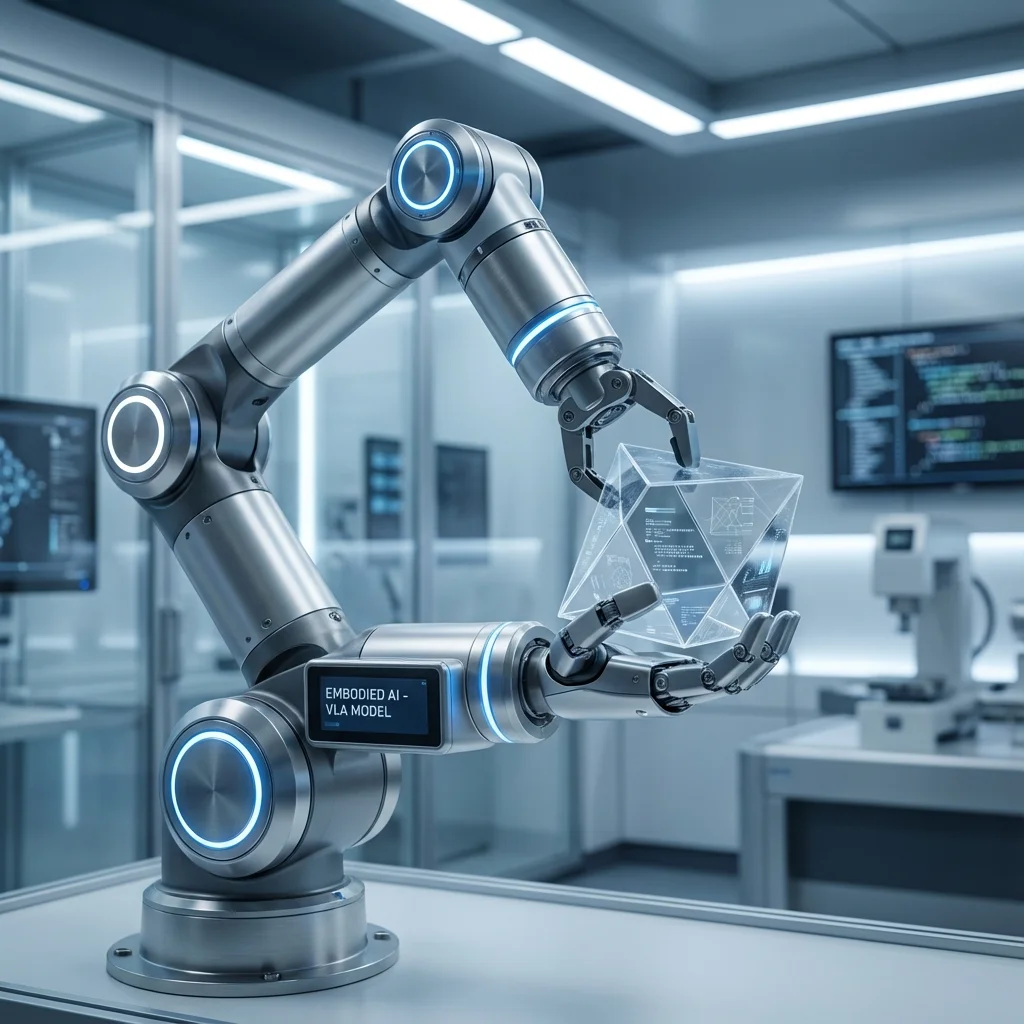
A robot that can chat about a screwdriver still may not know how to pick one up. Embodied AI robots are forcing the AI field to face that gap: intelligence is not only about words, images, or code, but about pressure, balance, timing, friction, and messy rooms. The core idea is simple enough. A machine learns by acting in the world, reading what happens, and adjusting its next move. That is why environmental interaction matters more than polished demo videos. A robot folding a towel, loading a dishwasher, or moving a warehouse bin must learn from contact, not from text alone. For readers tracking practical technology coverage, this shift explains why robotics is becoming one of the most watched AI stories in the USA.
Google DeepMind’s Gemini Robotics work, NVIDIA’s GR00T platform, and MIT’s embodied intelligence research all point in the same direction: the next hard problem is not making AI sound smarter. It is making machines act safely and usefully in places built for people.
Why Embodied AI Robots Learn Best From Contact, Not Commands
Text can describe a kitchen drawer, but it cannot tell a machine how much force a sticky drawer needs on a humid August morning in Houston. That lesson arrives through touch, failed attempts, and feedback from the room itself. This is where physical robot learning starts to matter. The robot is not memorizing a script. It is building a working feel for objects, surfaces, and limits.
The gap between knowing and doing
A language model can explain how to tie a knot. A robot hand has to manage rope tension, finger placement, shifting loops, and the tiny moment when slack becomes structure. That difference sounds small until you watch a robot drop the rope for the tenth time.
The non-obvious point is that failure is not always a bad training signal. In robot task training, a bad grip can teach more than a clean success because it shows where the body, sensor, and plan disagree. A warehouse robot that bumps a soft package edge learns something a product photo never gave it.
Google DeepMind describes Gemini Robotics as a vision-language-action model built to connect perception, language, and movement, while Gemini Robotics-ER focuses on spatial and temporal reasoning for physical agents. That matters because a robot must turn “put this in the box” into a path, a grip, and a safe motion around nearby objects.
Why homes are harder than factories
Factories look hard because the machines are big. Homes are harder because nothing stays put. A coffee mug may be on the counter today, near the sink tomorrow, and half-hidden behind cereal boxes by Friday.
That is why environmental interaction beats a fixed instruction set. The machine has to read the room in front of it, not the perfect room from a training video. A robot that can clean one model kitchen may still freeze in a real apartment with dim lighting, a wet floor, and a dog circling its wheels.
This is also why the USA market will not adopt home robots at the same pace as warehouse robots. A fulfillment center can control shelf height, labels, lighting, and pathways. A family kitchen in Ohio offers no such mercy. The robot has to adapt, and that makes the learning loop slower but more honest.
For deeper background, a future internal post on AI-powered home automation could connect this robotics shift with smart home products Americans already use.
Environmental Interaction Turns Rooms Into Teachers
A robot’s classroom is not a screen. It is the room, the tool, the floor, and the object that refuses to behave. Environmental interaction gives the machine a stream of small corrections. When the cup slips, the arm overreaches, or the wheels lose traction, the system gets a lesson it could not get from language alone.
Feedback is the real curriculum
The best teacher in robotics is often the object. A sponge compresses. A metal pan rings when tapped. A cardboard box bends before it tears. Each response tells the robot something about weight, force, and shape.
This is why physical robot learning often mixes real-world data, simulation, human videos, and robot demonstrations. NVIDIA’s GR00T N1 paper describes a vision-language-action model trained with real robot trajectories, human videos, and synthetic datasets, then tested on language-guided two-arm manipulation tasks.
A non-obvious insight: simulation is not fake practice when used well. It is a cheap rehearsal space. The robot can learn broad motion patterns there, then use the real room to correct the parts that simulation got wrong. That split can save time without pretending pixels are the same as physics.
The best robot training looks boring
People expect the future to arrive with humanoids sprinting through labs. The more meaningful progress may look dull: opening drawers, moving towels, sorting bins, and clearing tables.
Boring is useful.
A robot that can repeat small tasks in varied rooms is closer to real value than one that performs a flashy stunt under perfect lighting. In a senior living facility, for example, carrying laundry without blocking a hallway would mean more than dancing on stage. In a Dallas warehouse, picking oddly shaped returns may save more money than a humanoid handshake.
Robot task training improves when engineers stop chasing drama and start measuring ordinary reliability. Can the machine recover after a mistake? Can it ask for help when a drawer is jammed? Can it avoid a child’s backpack on the floor? These questions sound plain because they are the questions that decide adoption.
The New Robotics Stack Is More Than a Smarter Model
A smarter model helps, but it does not carry the whole machine. A useful robot needs sensors, motors, safety checks, training data, edge computing, battery planning, and a way to recover when the world gets weird. That stack is why robotics has moved slower than chatbots. Words are cheap to retry. Physical motion carries cost.
Vision-language-action models need guardrails
The phrase “vision-language-action” sounds neat, but the action part raises the stakes. When an AI answer is wrong, you can delete it. When a robot arm is wrong, it may hit a shelf, crack a plate, or scare a person.
Google DeepMind’s robotics work includes safety research, and its public materials discuss models that reason about physical tasks and plan actions in the real world. NVIDIA has also pushed robotics safety software, including a 2026 suite focused on humanoid robotics safety rather than building the physical robots itself.
The lesson for American companies is blunt: do not treat robot safety as a feature added near launch. It has to shape the whole product. The NIST AI Risk Management Framework gives organizations a useful starting point for thinking about AI risks across design, testing, deployment, and monitoring.
General robots may arrive through narrow jobs first
The public loves the dream of one robot that can do everything. The market may reward machines that do one useful job well.
A hospital delivery robot does not need to cook dinner. A construction-site robot may only need to carry materials across mapped paths. A farm robot may begin by spotting weeds, not running the whole field. That narrowness is not weakness. It is a path to trust.
This is where robot task training should be judged by business fit, not science-fiction appeal. A machine that handles 80 percent of a repetitive task with clear handoff rules can be worth buying. A machine that claims general skill but fails in corner cases becomes expensive theater.
For readers building topic clusters, how artificial intelligence is changing industrial work would make a strong companion piece because robotics adoption will likely show up first in jobs with repeatable motion and measurable savings.
What This Means for Workers, Homes, and Trust in the USA
American readers tend to ask the practical question first: will these robots take jobs, help workers, or become another overhyped gadget? The honest answer depends on where they land. In warehouses, hospitals, farms, labs, and assisted living, machines that learn through environmental interaction could reduce strain and handle dull tasks. In homes, the road is longer because personal spaces are unpredictable.
The first wins will feel small
A robot that moves totes in a warehouse does not sound dramatic. Neither does a machine that wipes tables in an airport lounge. Yet those early wins may matter most because they create data, trust, and better hardware.
MIT’s embodied intelligence work frames the field around understanding intelligent behavior in the physical world by bringing together perception, sensing, language, learning, and planning. That mix explains why progress is not one invention. It is many small systems learning to cooperate inside one moving body.
A counterintuitive point: the best early robots may not look human. Wheels, fixed arms, and simple grippers can beat humanoid shapes when the job is narrow. A humanoid form helps in spaces built around people, but it also adds balance problems, cost, and maintenance headaches.
Trust will be earned through recovery
People do not only judge a robot by whether it succeeds. They judge it by what it does after it fails.
If a robot drops a towel, does it try again safely? If it cannot identify a medicine bottle, does it stop and ask a human? If a child steps into its path, does it freeze early enough to feel calm rather than scary? These recovery behaviors will shape public trust more than raw intelligence scores.
Safety researchers are paying close attention to this problem because physical AI systems can fail through bad perception, poor planning, unsafe instructions, or confusing human interaction. A 2026 safety survey described embodied systems as agents that must work in open-world, safety-sensitive settings where failures can cause physical harm.
That is why the future of physical robot learning is not only a lab race. It is a trust race. The winners will not be the machines that perform one perfect demo. They will be the ones that make safe, boring, useful progress in real spaces.
Conclusion
The next stage of AI will be judged less by how well machines talk and more by how well they handle the stubborn details of the physical world. A robot must learn that a full grocery bag swings, a glass table reflects, a hallway changes during the day, and a person nearby deserves extra space. That kind of knowledge comes from contact, correction, and repeated work in real settings.
For businesses, the smart move is to start with narrow tasks, strong safety rules, and honest performance tests. For homeowners, patience is wise. The home robot that handles every chore is still farther away than the headlines suggest, but embodied AI robots are getting better at the small actions that make larger abilities possible.
The real breakthrough will not feel like magic. It will feel like a machine doing a useful task twice, then ten times, then every day, without making the room harder for the humans inside it.
Frequently Asked Questions
How do robots learn physical tasks through environmental interaction?
They act, sense the result, and adjust the next movement. A robot may try a grip, notice the object slipping, then change finger pressure or angle. Over time, that feedback helps it connect visual input, force, timing, and motion.
Is physical robot learning different from normal AI training?
Yes. Normal AI training often works with text, images, or data files. Physical robot learning includes movement, touch, weight, balance, and safety. The robot has to test actions in a real or simulated space, then learn from what happens.
Why is environmental interaction important for robot task training?
It gives the robot information that instructions cannot provide. A command can say “pick up the cup,” but the room tells the robot where the cup is, how heavy it feels, whether it slips, and what objects are nearby.
Will home robots become common in the USA soon?
Some narrow home robots will improve, but general chore robots still face hard problems. Homes are cluttered, personal, and unpredictable. Expect progress in limited tasks first, such as floor care, simple carrying, or support for older adults.
What jobs could physical AI robots handle first?
Warehousing, hospital delivery, farm inspection, lab support, and light manufacturing are strong early areas. These settings offer repeatable tasks, clearer safety zones, and measurable savings. That makes adoption easier than in open-ended home environments.
Are humanoid robots better than wheeled robots?
Not always. Humanoid robots fit spaces made for people, such as stairs and standard counters. Wheeled robots can be cheaper, steadier, and easier to maintain for many jobs. The right body depends on the task, not the hype.
What makes robot safety harder than chatbot safety?
A chatbot can give a bad answer, but a robot can move through space and affect people or objects. Safety has to cover sensing, planning, motion, recovery, human behavior, and hardware limits. That makes testing much tougher.
How should companies test robots before using them?
They should test ordinary failures, not only best-case demos. That means blocked paths, bad lighting, dropped objects, confusing instructions, and nearby people. A useful robot needs safe recovery behavior, clear handoff rules, and steady results over time.