
A floating bead looks like a parlor trick until you ask what touched it. Acoustic Levitation Technology now matters because the answer can be “nothing solid at all,” and that single detail changes how labs handle droplets, crystals, particles, and fragile samples. For readers who follow emerging science and technology updates, the shift is not about sci-fi displays. It is about cleaner testing, fewer contaminated samples, and machines that move tiny objects with sound fields instead of tweezers, tubes, or trays. NASA tested acoustic containerless processing in space decades ago, including heating and cooling samples without contact, but newer work with ultrasonic phased arrays has made the idea easier to steer on Earth. Researchers have shown contactless droplet mixing, protein crystal testing, magnetic resonance work on microliter droplets, and even droplet control for optical cleaning and condensation systems. The leap from “look, it floats” to “this solves a handling problem” is the whole story.
Why Sound-Based Handling Is Leaving the Lab Bench
The old appeal was visual. A foam ball hangs in the air, a droplet trembles between a speaker and a reflector, and everyone smiles. That was enough for a classroom demo, but not enough for industry. Real users ask harder questions. Can it mix a sample? Can it avoid contamination? Can it work with a repeatable path, not a lucky balance point?
The hidden cost of touching small samples
Containers feel harmless until you work at tiny volumes. A droplet inside a tube touches plastic. A crystal on a mount touches fiber or film. A particle gripped by a tool may pick up residue, heat, static, or mechanical stress. At normal scale, that looks minor. At microliter scale, it can be the experiment.
That is why contactless material handling has a serious audience in U.S. research labs. A drug discovery team does not need a levitating marble. It needs a way to keep a protein crystal wet, accessible, and less disturbed while an X-ray beam collects data. Scientific Reports published work showing room-temperature X-ray protein crystallography with ultrasonic levitation, where protein crystals sat in liquid droplets and showed no detected damage from the sound-based handling.
The non-obvious part is this: the floating effect is not the product. The product is the missing wall. Once the container disappears, the sample’s surface becomes easier to study. Evaporation, mixing, crystal motion, and chemical change can be watched without the container adding its own behavior.
Why tiny payloads are not a weakness
People often dismiss the field because it handles small things. That misses the point. Small is exactly where the pain lives. A pharmaceutical sample, a biological droplet, a thin film, or a fragile electronic part does not need a forklift. It needs control without bruising.
A U.S. manufacturer would not install a sound field to lift a wrench. But a lab automation company might use it to move levitated droplets between inspection points. A hospital research center might study a microliter sample without a plastic surface. A chip packaging team might explore non-contact motion for parts that hate scratches.
This is where the technology starts to look less like a magic act and more like a clean-room tool. The closer the work gets to small volumes, soft matter, or delicate surfaces, the more sense it makes. Big force is less valuable than gentle repeatability.
Where Acoustic Levitation Technology Leaves the Demo Table
The move into applications depends on steering. A static levitator can hold a bead. A useful system must trap, move, merge, rotate, separate, and release. That is why the most interesting progress centers on field control, not louder sound. The question is no longer whether sound can hold matter. It is whether software can shape the sound well enough to do a job.
Levitated droplets become tiny workstations
Levitated droplets are a strong fit because they behave like small, floating workbenches. You can watch them dry. You can merge them. You can mix them. You can expose them to light, heat, or measurement tools while leaving their outer surface open.
Nature’s Scientific Reports described contactless droplet coalescence and active mixing in air using an ultrasonic phased array. The researchers controlled the acoustic potential to bring droplets together and help liquid mix without a physical stirrer. That matters because mixing inside a tiny droplet is not automatic. Surface tension can make the droplet look calm while the inside still carries uneven concentration.
Here is the practical angle. A lab does not care that the droplet floats for its own sake. It cares that a small reaction can happen with less wall contact, less sample waste, and better visual access. That can matter in analytical chemistry, biomaterials, and early drug research, where one bad surface interaction can bend the result.
Ultrasonic phased arrays make movement programmable
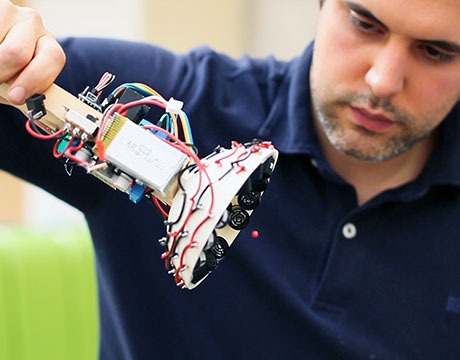
The real step forward is not a single speaker. It is the array. Ultrasonic phased arrays use many small transducers whose timing can be controlled so the pressure field forms where the system needs it. Change the timing, and the trap moves.
That shift makes the hardware feel closer to a printer head or robotic stage. Instead of a fixed floating point, you get a field that can move matter through space. Researchers have used this kind of control for three-dimensional motion of particles and for droplet handling. The same logic also supports acoustic tweezers, which use sound radiation forces to hold and move matter without contact.
The counterintuitive lesson is that better levitation may look less dramatic. A stable, modest, repeatable trap beats a flashy floating object every time. Industry does not pay for spectacle. It pays for fewer failed samples, cleaner measurements, and machines that behave the same way on Tuesday morning as they did during the demo.
The U.S. Industries Watching Contactless Material Handling Closest
The first serious buyers will not be people trying to float toys. They will be teams with expensive samples and strict process rules. That points toward pharmaceuticals, biotech, advanced materials, electronics, aerospace, and high-end optics. Each field has its own reason, but the shared need is simple: move or study something small without adding a dirty touch.
Drug discovery wants cleaner room-temperature tests
Biology does not always like the tools used to study it. Cooling, mounting, drying, and container walls can change how a sample behaves. Room-temperature protein work matters because many biological molecules act differently when frozen or pinned down.
That is why sound-based handling has appeal in structural biology. The 2016 Scientific Reports protein crystallography study used ultrasonic levitation with a high frame-rate detector and reported a structure matching the conventional method up to a 1.8-angstrom resolution limit. The research also checked for crystal damage from the acoustic process.
For a U.S. biotech lab, the selling point would not be “floating samples.” It would be sample efficiency. If a team can get useful data from less material, with less handling, the workflow becomes less wasteful. That can matter when a protein is hard to produce or a test compound costs too much to spill.
Electronics and optics care about surfaces, not spectacle
Electronics manufacturing and optical systems share an obsession with surfaces. Dust, scratches, droplets, and contact marks can ruin value fast. A lens with condensation is not broken, but it is useless until cleared. A tiny part may pass inspection until one handling step damages it.
Recent work on a droplet ultrasonic tweezer showed programmable control of multiple droplets, movement across layered surfaces, and possible use in optical surface cleaning, condensation heat transfer, and atmospheric water harvesting. The study used a twin-trap field from a phased-array design and showed droplet coalescence and removal behavior that points beyond the lab demo.
That is the kind of detail that should catch attention. The tool does not need to lift a product through the air. It might only need to pull droplets together on a camera lens or help clear water from a sensor window. The first useful devices may be boring from the outside and clever inside.
For more background, a related internal resource like advanced manufacturing trends could sit near this topic because the market story is less about floating objects and more about cleaner process control.
What Still Blocks Real Adoption
Every promising lab tool has a rough middle stage. This field is there now. Researchers have proven many pieces, but an industrial tool must handle messy rooms, cost limits, calibration drift, safety rules, and operator training. The sound field does not care about a press release. It cares about air temperature, geometry, sample shape, and control.
Scale, noise, and airflow keep the promise honest
Sound needs a medium. Air helps in many setups, but air also moves, warms, cools, and carries disturbances. A tiny draft can matter. So can a nearby surface. A droplet can deform, spin, evaporate, or break apart if the pressure field drives too much motion inside it.
A 2025 Nature Communications paper on contact-free magnetic resonance used a demagnetized acoustic levitator to study liquid samples without containers. It also notes small-volume objects in the 0.5 to 5 microliter range and ultrasound standing waves at frequencies at or above 20 kHz. That tells you where many near-term use cases live: small samples, controlled setups, and measurement workflows, not warehouse-scale transport.
The hard truth helps. Contactless material handling will not replace every gripper, pipette, or tray. It will win where contact is the problem, not where contact is cheap and harmless. That boundary makes the business case cleaner.
The first products may hide inside machines
The most likely path to adoption is quiet. You may not see a consumer product labeled “sound levitator.” You may see a lab instrument that uses acoustic trapping in one stage. You may see an inspection machine that keeps a droplet away from a surface. You may see a specialty material system that reduces contamination during heating, drying, or scanning.
NASA’s older work already showed why containerless processing matters. A NASA Technical Reports Server record describes high-temperature processing in microgravity, where specimens were positioned, heated, melted, cooled, and solidified without touching a container or surface. During the STS-61A test, samples were processed at 600 to 1500 C.
That history matters because it proves the idea has never been only a toy. The newer shift comes from control, price, sensors, and software. Better arrays and smarter feedback can turn a delicate physics setup into a tool a technician can trust. For readers building topic clusters, emerging science tools for U.S. labs would connect well here.
Conclusion
The future of sound-based levitation will not arrive as a giant floating chair or a warehouse full of hovering boxes. It will show up first in places where touch is the enemy: small samples, wet chemistry, fragile crystals, fine surfaces, and research workflows that need clean access from every side. That is a narrower promise, but it is also a stronger one. Acoustic Levitation Technology becomes useful when it stops trying to impress everyone and starts solving expensive little problems. The U.S. labs and manufacturers that understand that will test it sooner, because they already know the cost of contamination, wasted samples, and damaged surfaces. The next step is not hype. It is integration. Watch the instruments, not the stage demos, because that is where sound may become a working hand.
Frequently Asked Questions
How does sound make small objects float?
Sound waves create pressure patterns in the air. At certain points, the upward acoustic force can balance gravity for tiny objects or droplets. The object settles into a stable region of the sound field, so it appears to float without a solid support.
Is acoustic levitation safe for lab samples?
It can be safe for some samples, but it depends on sound intensity, droplet size, exposure time, and sample type. Gentle, controlled fields may protect fragile materials from surface contact, while stronger fields can deform droplets or disturb sensitive biological matter.
What are the best real-world uses right now?
The strongest near-term uses include contactless droplet mixing, protein crystal studies, small-volume chemistry, surface cleaning research, and containerless material testing. These areas benefit because the sample stays accessible and avoids contact with tubes, mounts, or walls.
Can this technology lift heavy objects?
Not in the way most people imagine. Common research systems focus on particles, droplets, thin films, and small samples. Larger objects need far more force and control, which makes the setup harder, louder, and less practical for normal industrial use.
Why do researchers use ultrasonic phased arrays?
Ultrasonic phased arrays let researchers shape and move pressure fields with software-controlled timing. That makes traps more flexible than a fixed speaker-and-reflector setup. The array can steer small objects, merge droplets, or create several controlled positions.
Could this help pharmaceutical research?
Yes, especially in early research where samples are tiny and expensive. It may help with room-temperature crystal testing, low-volume reactions, and cleaner sample handling. The value comes from reducing unwanted contact, not from making the sample float for show.
What limits adoption outside research labs?
The main limits are payload size, stability, airflow sensitivity, calibration, cost, and workflow fit. A system also needs clear advantages over pipettes, grippers, trays, or microfluidic chips. It wins only when contact causes a real problem.
Will consumers see acoustic levitation products soon?
Most consumers may never notice it directly. The first practical uses will likely sit inside lab instruments, inspection tools, optical systems, or specialty manufacturing equipment. The technology may become valuable long before it becomes visible to ordinary buyers.